



Finding the right childcare can feel overwhelming, especially when you are trying to balance your child’s needs, your work schedule, your budget, and the kind of environment that feels right for your family. In a city like Calgary, parents have several childcare options to choose from, and each one offers something a little different.
The best choice often comes down to your child’s age, personality, daily routine, and the level of flexibility your family needs. Some families want a structured classroom setting. Others prefer a smaller, home-like environment. Some need full-time care during standard working hours, while others need support in the evenings or on weekends.
This guide will walk you through the main types of daycare in Calgary, how they compare, and what to look for when deciding which option is the right fit for your child.
Understanding Childcare Options in Calgary
When parents search for daycare in Calgary, they often find several terms used at once, including daycare centres, dayhomes, preschools, and out-of-school care. While they all fall under the wider childcare category, they are designed for different ages, schedules, and family needs.
That is why it helps to look beyond the word “daycare” and understand how each option works in real life. The right childcare setting is not only about supervision. It is also about how your child learns, socialises, rests, eats, and feels throughout the day.
Licensed Daycare Centres
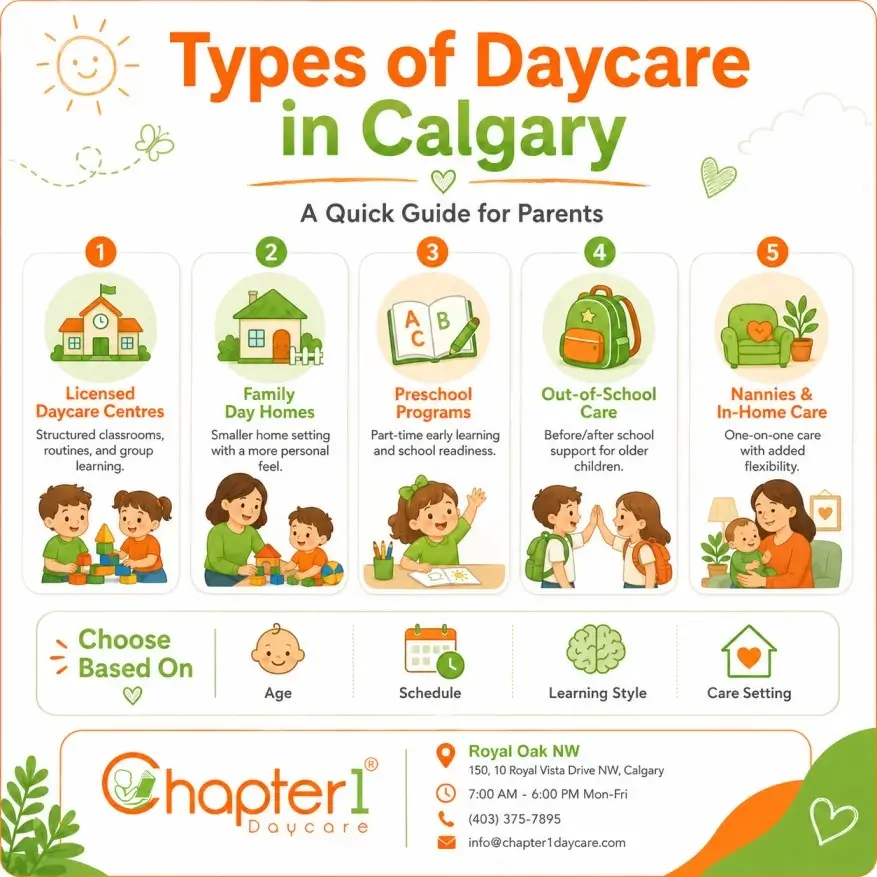
Licensed daycare centres are one of the most common choices for Calgary families. These are structured childcare settings that usually group children by age, such as infants, toddlers, preschoolers, and pre-kindergarten children.
These centres often follow a daily routine that includes meals, play, learning activities, nap time, and outdoor play. For many working parents, this type of care offers consistency, reliability, and a clear schedule that makes day-to-day planning easier.
A licensed daycare centre may be a strong fit if you want:
- age-based classrooms
- a structured daily routine
- more opportunities for group learning and social development
- full-time care during the week
- a setting that blends care with early education
Many parents also feel more comfortable with a centre setting because there is usually a team of educators, which can make staffing more dependable. If one teacher is away, there is often backup support available.
Family Day Homes
Family day homes, often called dayhomes, provide childcare in a home setting rather than a larger centre. This option can feel more personal and quieter, which some children respond to very well.
A dayhome may include a smaller group of children and mixed ages in the same environment. For parents who want a more home-like atmosphere, this can be a very appealing option. It may also feel easier for children who need a calmer setting or who are adjusting to care for the first time.
Some families choose dayhomes because they value:
- smaller group sizes
- a home-based routine
- mixed-age interaction
- a more intimate environment
- a setting that may feel less overwhelming for young children
That said, parents should still look closely at the quality of care, daily routine, communication style, and safety practices. Not all home-based childcare experiences are the same, so asking the right questions matters.
Preschool Programs
Preschool programs are designed more specifically for early learning and school readiness. They are usually geared toward children around ages 3 to 5 and often run part-time rather than full-day.
This type of program can be a great option for families who do not need full-time childcare but want their child to build confidence, independence, and early classroom skills before kindergarten. Preschool settings often focus on group activities, play-based learning, routines, creativity, and social development.
Preschool can help children practise important skills such as:
- following instructions
- taking turns
- joining group activities
- building early language and number awareness
- becoming more comfortable in a classroom-style environment
For many parents, preschool is less about long childcare hours and more about preparing a child for the next stage of learning.
Out-of-School Care
Out-of-school care is designed for school-aged children who need supervision and support before school, after school, on PD days, or during school breaks. This is especially helpful for working parents whose schedules do not match school hours.
Rather than replacing school, this option fills in the gaps around the school day. Children may receive snacks, take part in activities, complete homework, and enjoy free play in a safe, supervised setting.
This kind of care can be particularly valuable for families who need:
- before-school drop-off
- after-school pick-up support
- childcare on non-school days
- a reliable routine during the workweek
For parents with older children, out-of-school care can be one of the most practical and dependable childcare solutions in Calgary.
Nannies, Babysitters, and In-Home Care
Some families prefer childcare to happen in their own home. In these cases, they may choose a nanny or babysitter rather than a daycare setting.
A nanny usually provides more regular and ongoing care, while a babysitter may help on a part-time, occasional, or short-term basis. In-home care can be ideal for parents who want one-on-one attention, have multiple children with different schedules, or need greater flexibility.
This option can work well, but it often comes at a higher cost. It also places more responsibility on parents to manage the arrangement, confirm qualifications, and ensure the care setup works well over time.
Licensed vs. Unlicensed Childcare
One of the most important things to understand when choosing childcare in Calgary is the difference between licensed and unlicensed care. This can affect not only the structure of the program, but also your confidence as a parent when it comes to standards, oversight, and day-to-day consistency.
Licensed childcare usually gives parents added reassurance because it operates within a regulated framework. That often means clearer expectations around staff, safety, programming, and accountability.
Unlicensed care may still work for some families, but it requires even more personal research. Parents need to be especially careful about checking the environment, routines, caregiver experience, and overall quality of care.
Which Type of Daycare Is Best for Your Child?
There is no single answer that works for every family. The best type of daycare depends on what your child needs most and what your household schedule looks like.
A child who enjoys activity, routine, and lots of peer interaction may do very well in a daycare centre. A child who prefers quieter surroundings may be happier in a smaller dayhome. A 4-year-old preparing for kindergarten may benefit from a preschool-focused environment, while a school-aged child may simply need dependable before- and after-school care.
When choosing, think about:
- your child’s age and stage
- your child’s personality
- your work hours
- how much structure you want
- whether you need full-time, part-time, or flexible care
- how important school readiness is right now
The goal is not to choose the most popular option. It is to choose the one that gives your child the right mix of comfort, support, and opportunity to grow.
What To Look For During a Daycare Tour
A daycare tour can tell you far more than a website alone. It gives you the chance to see how children are treated, how the space feels, and whether the environment matches what your family wants.
Pay attention to how educators speak to children, how engaged the children seem, how clean and organised the rooms are, and whether the day feels calm and well-managed. Look at the learning materials, nap spaces, outdoor areas, and meal setup.
It also helps to ask practical questions about communication, routines, discipline approach, staff consistency, and how the daycare handles transitions, illnesses, and emergencies.
Why Flexible Childcare Matters More Than Ever
Many families do not work the same schedule anymore. Some parents work evenings, weekends, rotating shifts, or longer hours that do not line up with a traditional childcare model.
That is why flexible childcare has become such an important factor in Calgary. A daycare may look great on paper, but if the hours do not match your real routine, the arrangement may become stressful very quickly.
For modern families, flexibility can make a major difference in reducing daily pressure. It can also create more stability for children, because they are in a consistent care environment instead of switching between multiple caregivers.
How Much Do Different Types of Daycare Cost in Calgary?
The cost of childcare in Calgary depends on the type of care you choose. For licensed daycare centres, licensed dayhomes, and preschool programs that participate in Alberta’s affordability model, many families pay a regulated parent fee of $326.25 per month for full-time care (100+ hours) or $230 per month for part-time care (under 100 hours). At Chapter1 Daycare, this same simple fee structure applies across programs, which makes licensed childcare and preschool more predictable and affordable for families.
Other childcare types can cost more. Private or unlicensed dayhomes often set their own rates, and full-time care may range from around $800 to $1,500+ per month, depending on the area and the child’s age. Nannies and in-home care are usually among the most expensive options because families are paying for more personalised, one-on-one support. When comparing daycare types, it helps to look beyond the base cost and consider what is included, such as learning activities, meals, hours of care, and schedule flexibility.
Choosing a Daycare That Supports Learning and Family Life
The best childcare settings do more than simply watch children during the day. They help children feel secure, build confidence, explore new ideas, and develop social and emotional skills in a safe, caring environment.
Parents should also feel supported. Clear communication, predictable routines, transparent pricing, and a caring team can make the entire experience easier and more reassuring.
That balance matters. Families are not just choosing a building or a schedule. They are choosing the people and environment that will become part of their child’s daily story.
A Local Option for Calgary Families
For parents looking for childcare that blends nurturing care with structured early learning, Chapter1 Daycare offers a warm and supportive environment for Calgary families. With programs for infants, toddlers, preschoolers, and pre-kindergarten children, along with flexible scheduling options, it reflects what many families are truly searching for today: safe care, strong communication, affordable options, and a place where children can play, learn, and grow with confidence.
Final Thoughts
Choosing among the different types of daycare in Calgary takes time, but understanding your options makes the decision much easier. Whether you are considering a licensed daycare centre, a dayhome, a preschool program, out-of-school care, or in-home support, the best choice is the one that fits your child and your family’s real needs.
Look for a place where your child feels comfortable, where the caregivers communicate well, and where the daily routine supports both development and peace of mind. When those pieces come together, childcare becomes more than a service. It becomes a trusted part of your family’s life.
FAQs
What are the main types of daycare in Calgary?
The main childcare options in Calgary include licensed daycare centres, family day homes, preschool programs, out-of-school care, and in-home care such as nannies or babysitters.
What is the difference between a daycare centre and a dayhome?
A daycare centre usually has larger age-based classrooms and a more structured routine, while a dayhome offers care in a home setting with a smaller group of children.
Is preschool the same as daycare?
Not always. Preschool is usually more focused on early learning and school readiness, while daycare often provides longer hours and full-day childcare for working families.
What type of daycare is best for toddlers?
That depends on the child. Some toddlers do well in a structured daycare centre, while others thrive in a smaller, quieter dayhome environment.
How do I choose the right daycare in Calgary?
Start by looking at your child’s age, personality, schedule needs, and the kind of environment that feels right for your family. Touring the location and asking detailed questions can also help.
Are there childcare options in Calgary with flexible hours?
Yes. Some childcare providers offer part-time care, extended hours, and care designed to better support families with non-traditional work schedules.