


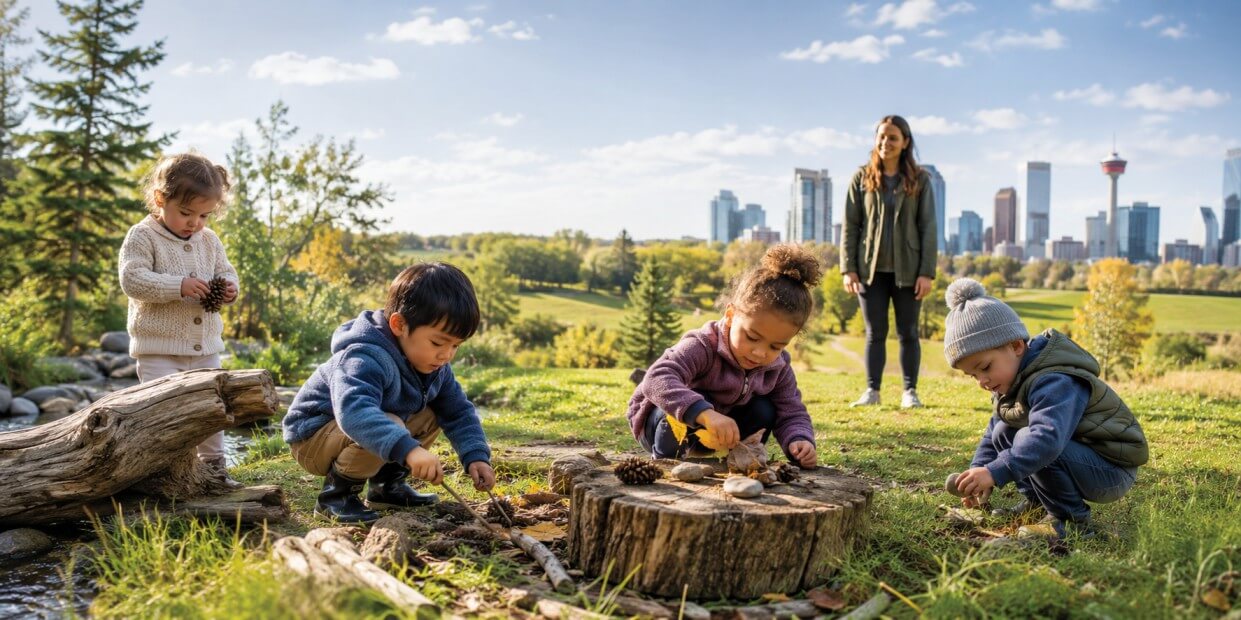
Children are naturally drawn to the outdoors. A patch of snow, a pile of leaves, an interesting stone, or a puddle can quickly become the starting point for movement, imagination, conversation, and discovery.
Nature play gives children the freedom to interact with the world around them using their bodies and senses. In Calgary, each season offers different opportunities for children to explore, solve problems, build confidence, and develop important early-learning skills.
What Is Nature Play?
Nature play is open-ended play that takes place outdoors or uses natural materials. It may include digging in soil, collecting leaves, balancing on logs, observing insects, building with sticks, making shapes in snow, or simply noticing the sounds and colours in an outdoor space.
Unlike an activity with a fixed outcome, nature play allows children to decide what materials represent and how the experience develops. A pinecone can become pretend food, a treasure, a decoration, or part of a structure. This freedom encourages children to create their own ideas instead of following one set of instructions.
Nature play does not require a remote forest or specialized equipment. It can happen in a daycare yard, neighbourhood green space, local park, garden, or during a short walk through the community.
Why Nature Play Matters During Early Childhood
Young children learn through movement, repetition, relationships, and hands-on exploration. Natural environments provide changing surfaces, textures, sounds, shapes, and challenges that invite children to become active participants in their learning.
A child may compare two rocks, watch snow melt, notice that dry leaves sound different from wet ones, or work out how to carry several sticks at once. These small discoveries support physical, cognitive, emotional, and social development at the same time.
Outdoor experiences also create a healthy balance within the day. Children can move more freely, use their voices differently, and explore ideas that may not be possible in an indoor classroom.
Nature Play Builds Strength, Balance, and Coordination
Natural outdoor spaces encourage children to move their bodies in varied ways. Instead of walking only across smooth floors, children may step over roots, move through snow, climb a gentle slope, crouch to examine something, or balance on an uneven surface.
These movements strengthen growing muscles and help children become more aware of where their bodies are in space. Regular outdoor experiences can complement a play-based curriculum that supports physical development through movement.
Developing Gross Motor Skills
Running, jumping, climbing, lifting, pushing, and carrying all support gross motor development. These larger movements help children improve their balance, coordination, strength, and overall body control.
Nature often makes movement more interesting. Carrying a bucket of snow, moving branches to create a pretend shelter, or jumping across a line of stones gives children a meaningful reason to use their bodies.
Strengthening Fine Motor Control
Nature play also gives children many opportunities to use the smaller muscles in their hands and fingers. Picking up pebbles, arranging leaves, drawing lines in soil, peeling bark from a fallen twig, or making tiny shapes in snow requires careful hand control.
Fine motor development supports everyday independence. Children rely on these skills when they use utensils, fasten clothing, draw, turn book pages, and eventually begin writing.
Outdoor Exploration Encourages Brain Development
Nature is always changing. Wind moves leaves, sunlight creates shadows, water changes soil, and snow becomes softer as the temperature rises. These changes invite children to observe, predict, test ideas, and reconsider what they thought would happen.
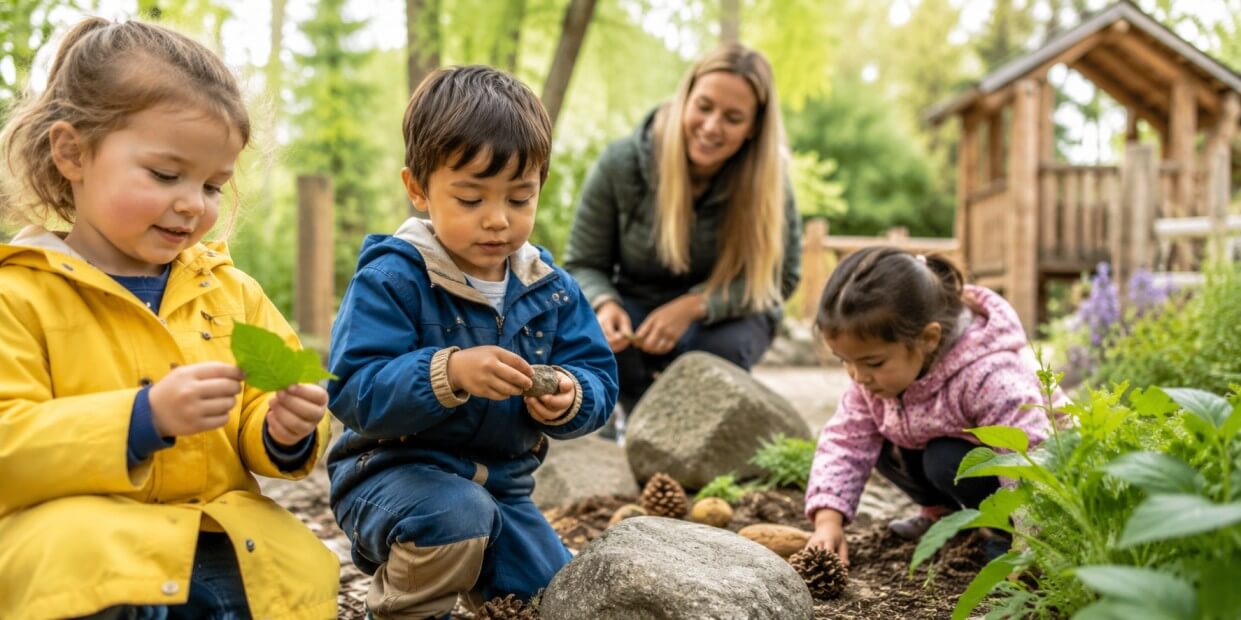
Outdoor play gives children real problems to solve. Instead of completing a worksheet about balance, a child may discover how to stop a stick structure from falling. Rather than being told which object is heavier, children can lift, compare, and reach their own conclusions.
Learning Cause and Effect
Nature play helps children see how actions produce results. Pouring water onto dry dirt creates mud. Placing snow in the sun causes it to melt. Dropping leaves from different heights shows how wind affects their movement.
These experiences create memorable learning because children can see and feel the results themselves. Educators can support the process by asking simple questions such as, “What do you think will happen?” or “Why did that one move faster?”
Developing Problem-Solving Skills
Outdoor environments rarely provide only one solution. A child deciding how to cross a puddle may step around it, jump over it, place an object across it, or ask a friend for help.
These decisions encourage flexible thinking, persistence, and independence. Age-appropriate outdoor challenges can also support the benefits of healthy risk-taking in childhood when educators provide safe boundaries and attentive supervision.
Nature Play Supports Creativity and Imagination
Many manufactured toys have a clear purpose. Natural materials are different because children can transform them through imagination. A stick can become a wand, fishing rod, spoon, bridge, microphone, or part of a pretend home.
This open-ended quality encourages storytelling and flexible thinking. Children decide what their materials mean, create their own rules, and adjust the activity as new ideas emerge.
Nature play also gives children space to move between structured and child-led experiences. Both approaches have value, and a thoughtful balance between structured and unstructured play helps children follow guidance while still developing independence and creativity.
Time Outdoors Can Support Emotional Well-Being
Young children experience busy days, new social situations, transitions, and strong emotions. Outdoor play can provide a welcome change of pace and give children more room to move, explore, and reconnect with their bodies.
Activities such as digging, walking, carrying natural materials, watching clouds, or listening to birds can support calm attention. Nature play does not remove every frustration, but it can become a positive part of a consistent routine that helps children feel settled and engaged.
Building Confidence Through Manageable Challenges
Nature presents small challenges that allow children to test their abilities. Stepping onto a low log, walking through deeper snow, climbing a gentle hill, or touching an unfamiliar texture may feel like a meaningful achievement.
When children complete these challenges with supportive supervision, they begin to trust themselves. They learn that it is okay to try, pause, make adjustments, and try again.
This confidence can carry into classroom activities, friendships, self-care routines, and other new experiences.
Nature Play Helps Children Learn Together
Outdoor spaces often encourage children to create shared games instead of gathering around a toy with only one purpose. They may work together to build a shelter, collect leaves, make pretend meals, or decide where a path should lead.
These experiences require communication. Children share ideas, assign roles, listen to one another, and adjust when someone introduces a different plan.
Disagreements may also happen, but these moments provide opportunities to practise patience, negotiation, and problem-solving. With gentle support from educators, children learn how to participate in a group while expressing their own ideas.
Nature Creates Rich Sensory Experiences
The outdoors engages several senses at once. Children may feel rough bark, hear snow crunching, smell damp soil, watch leaves move in the wind, and notice the temperature on their skin.
These sensory-rich experiences help children understand their surroundings and build descriptive language. They may begin using words such as smooth, frozen, slippery, crunchy, damp, heavy, or underneath because those words are connected to something they have actually experienced.
Nature exploration works especially well alongside other sensory learning experiences involving water, sand, movement, texture, music, and hands-on discovery.
How Nature Play Supports Early Learning
Outdoor exploration naturally introduces early science, mathematics, and language concepts. Children can sort leaves by colour, compare the sizes of stones, count pinecones, observe animal tracks, and notice how the weather changes.
Educators can build on these discoveries without turning nature play into a formal lesson. Simple questions and conversations help children think more deeply while keeping the experience enjoyable.
Nature play may help children practise:
- Counting, sorting, and comparing natural objects
- Learning words for textures, positions, colours, and movement
- Observing weather, plants, insects, and seasonal changes
- Creating patterns and structures with loose materials
- Remembering and explaining what they discovered
These skills support school readiness while respecting how young children learn best. Calgary families can also use simple outdoor activities for preschoolers to continue this type of learning beyond daycare.
Nature Play Through Calgary’s Seasons
Calgary’s changing seasons create different outdoor learning opportunities throughout the year. With suitable clothing, preparation, and careful weather monitoring, children can discover something new in every season.
Spring
Spring brings melting snow, puddles, mud, new plant growth, and changing temperatures. Children can observe water movement, listen for birds, look for early signs of growth, and compare wet and dry materials.
Summer
Warm weather creates opportunities for water play, gardening, insect observation, active movement, and exploring flowers or shaded green spaces. Children can spend longer periods creating games and investigating the world around them.
Autumn
Fallen leaves, seeds, wind, and changing colours provide natural materials for sorting, art, building, and imaginative play. Children can observe how the environment changes as colder weather approaches.
Winter
Snow offers opportunities for digging, building, carrying, tracking, and experimenting with melting and freezing. Winter play also requires children to adjust their movement as they walk through snow and navigate changing surfaces.
Is Nature Play the Same as Forest School?
Nature play and forest school share several ideas, but they are not exactly the same. Forest schools generally spend a significant amount of program time in natural outdoor environments and often follow child-led, place-based learning principles.
Children do not need to attend a specialized forest school to receive the benefits of outdoor exploration. Daycares, preschools, families, and community programs can all create meaningful nature experiences through regular outdoor routines and thoughtful use of natural materials.
The quality of the experience matters more than the label. Children benefit when they have enough time, freedom, supervision, and encouragement to explore with curiosity.
Keeping Nature Play Safe and Purposeful
Nature play should offer freedom within clear, age-appropriate boundaries. Educators inspect outdoor areas, choose suitable materials, monitor weather and air quality, and remain attentive while children explore.
Safe nature play may also involve:
- Appropriate clothing for Calgary’s conditions
- Clear boundaries within the outdoor area
- Close supervision near climbing or uneven surfaces
- Avoiding unsafe plants, objects, and choking hazards
- Handwashing after outdoor exploration
The goal is not to remove every challenge. It is to help children experience manageable challenges in a setting where caring adults can guide and support them.
Chapter1 Daycare incorporates outdoor movement, sensory discovery, collaborative play, and hands-on activities into a warm early-learning environment. Through age-appropriate programs and caring educators, children are encouraged to become more confident, curious, active, and independent. Families exploring a nurturing toddler program in Calgary can see how play, daily routines, and real-world experiences work together to support the whole child.
Helping Children Grow Through Outdoor Discovery
Nature play is not time away from learning. For young children, it is one of the most natural ways learning takes place.
As children run, build, collect, imagine, communicate, and solve outdoor problems, they strengthen their bodies and develop important thinking, emotional, and social skills. Calgary’s changing seasons add even more variety, allowing children to experience nature in new ways throughout the year.
By making outdoor exploration part of early childhood, families and educators give children the space to be curious, capable, and connected to the world around them.
FAQs
What Is Nature Play for Children?
Nature play is open-ended exploration involving outdoor spaces or natural materials such as water, soil, leaves, snow, stones, and sticks. Children decide how to use the materials while developing ideas through movement and discovery.
What Are the Main Benefits of Nature Play?
Nature play can support strength, coordination, creativity, problem-solving, confidence, communication, emotional regulation, and social development. Many outdoor experiences build several of these skills at the same time.
Is Nature Play Suitable for Toddlers?
Yes. Nature play can be adapted to a toddler’s age, interests, and abilities. Toddlers may enjoy touching safe natural materials, walking on different surfaces, collecting leaves, digging, pouring water, or observing nearby plants.
Can Children Enjoy Nature Play During Calgary Winters?
Yes. Snow, ice, tracks, winter sounds, and cold-weather movement create valuable learning opportunities. Children need suitable clothing, safe boundaries, close supervision, and weather conditions that are appropriate for outdoor play.
Is Nature Play the Same as Forest School?
Not exactly. Forest schools typically spend a substantial amount of time learning in natural outdoor settings. Nature play can also be incorporated into daycare, preschool, family routines, parks, and neighbourhood walks.
Does Nature Play Require Special Equipment?
No. Simple natural materials often encourage the most imaginative play. Leaves, sticks, stones, water, soil, and snow can be used in many different ways without specialized equipment.