


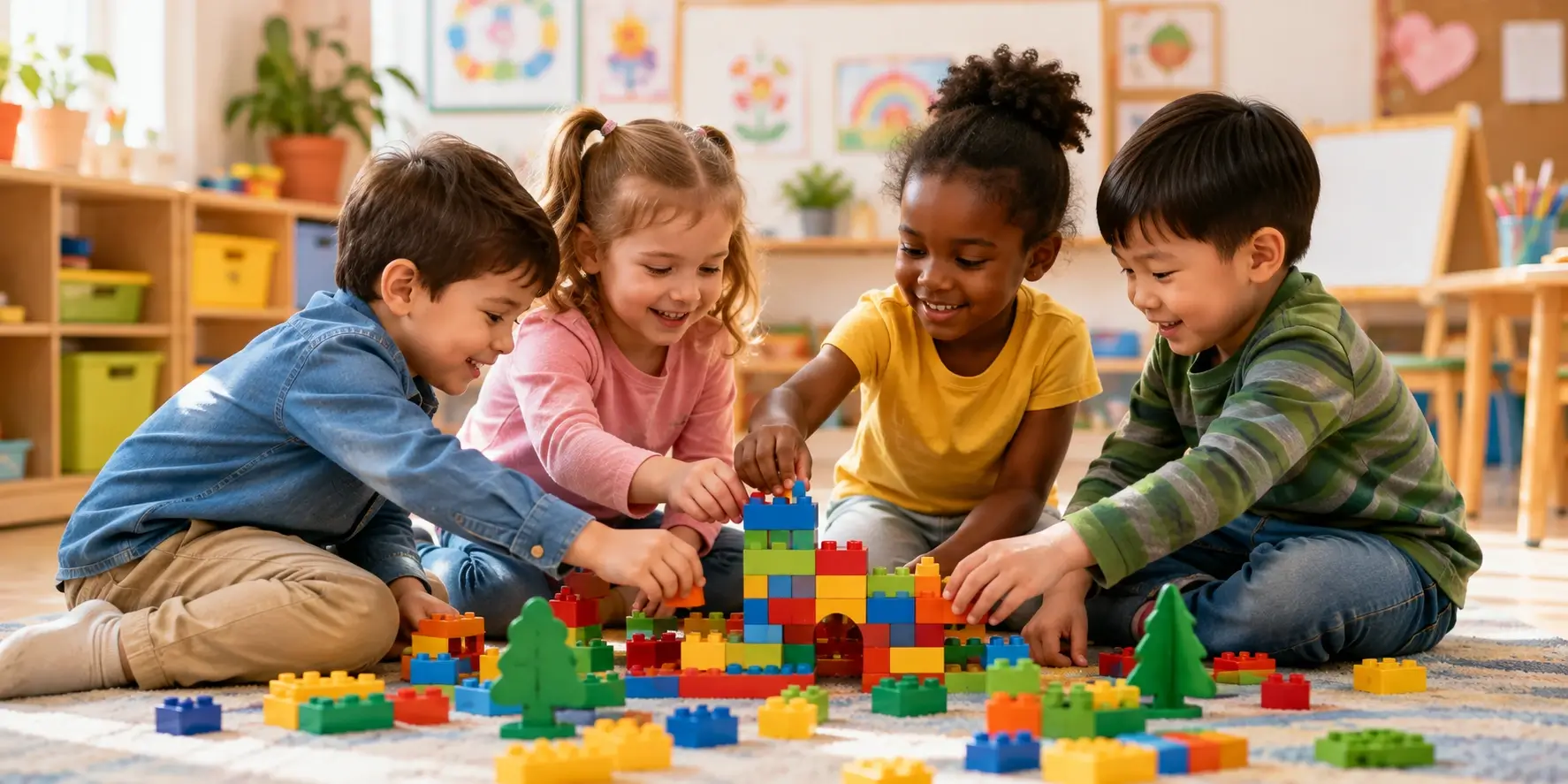
A group of children building a block tower may look like they are simply having fun. Look a little closer, however, and a lot of learning is happening. One child suggests where the next block should go, another waits for a turn, and someone else figures out what to do when the tower falls.
These everyday moments are examples of collaborative play. By playing with other children, young learners have opportunities to communicate, listen, cooperate, solve problems, understand feelings, and develop friendships. These abilities form an important part of healthy social and emotional development.
For young children, social skills are not learned only through direct instruction. They develop gradually through real experiences with other people. That is one reason play-based learning can be so valuable during the early years. Play gives children a meaningful and enjoyable way to practise skills they will use at daycare, at school, at home, and throughout everyday life.
What Is Collaborative Play?
Collaborative play happens when children interact and work together during the same activity. Instead of simply playing beside one another, they share ideas, materials, responsibilities, roles, or a common goal.
Children might work together to build a large block city, create a pretend restaurant, complete a puzzle, make a group art project, or invent an imaginative game. The activity itself can be simple. What matters is that children are communicating and responding to one another as the play develops.
That shared experience naturally creates social learning opportunities. Children discover that other people may have different ideas, preferences, emotions, and ways of solving problems. Learning how to respond to those differences is an important part of growing socially.
Where Does Collaborative Play Fit Into Early Childhood?
Children do not immediately begin playing cooperatively with other children. Social play develops gradually, and children may move between different types of play depending on their age, comfort level, personality, and situation.
Parallel Play
During parallel play, children may sit or play close to one another while remaining mainly focused on their own activity. Two toddlers, for example, might each build their own block structure while occasionally watching what the other child is doing.
Associative Play
As social interaction develops, children often begin sharing materials and talking about their activities. They may exchange toys or ideas without necessarily organizing their play around one shared objective.
Cooperative or Collaborative Play
Collaborative or cooperative play becomes more socially complex because children begin coordinating their actions. They may create roles, agree on rules, divide responsibilities, or work toward a shared result.
Children can still enjoy independent, parallel, or associative play after they begin cooperative play. Different forms of play can continue to serve different developmental needs throughout childhood.
How Collaborative Play Helps Children Build Social Skills
Many important social skills become easier to understand when children have opportunities to practise them instead of simply being told what to do. Regular interaction with peers gives children real situations in which communication, patience, empathy, and cooperation matter. Chapter1 also explores how these repeated peer experiences can help children develop social skills in daycare.
Children Learn to Communicate Their Ideas
Collaborative play gives children a reason to communicate. They might explain where a puzzle piece belongs, suggest what to build next, assign pretend-play roles, or ask another child for a toy.
They also begin discovering that communication involves listening. A child who wants friends to participate in a game has to hear their ideas and respond to what they say. These small conversations can gradually strengthen vocabulary, expressive language, listening, and social awareness.
They Practise Sharing and Taking Turns
Young children are still developing patience and self-control, so sharing does not always happen easily. Collaborative activities provide repeated, age-appropriate opportunities to practise.
Waiting for a paintbrush, passing building materials to a friend, or taking turns during a game helps children understand that other people have needs too. Over time, these experiences can support fairness, patience, and greater awareness of others.
Children Discover What Teamwork Means
Shared goals make teamwork easier for young children to understand. Imagine several children creating a pretend town. One child might build houses, another creates roads, and another gathers vehicles.
Each child contributes something different, but everyone is working toward the same idea. Through experiences like these, children begin to see that cooperation can accomplish something that would be harder to create alone.
Play Creates Opportunities to Work Through Conflict
Disagreements are a normal part of playing with others. Two children may want the same toy. Several children may disagree about the rules of a game. Someone may want to be the doctor while another child wants the same role.
These moments can become valuable learning experiences when adults provide appropriate support. Children can practise using words to explain what they want, listening to another viewpoint, suggesting alternatives, taking turns, and finding compromises.
The goal is not to make sure children never disagree. Learning how to respond respectfully when disagreements happen is itself an important social skill.
Children Begin Understanding Other People’s Feelings
Collaborative play also gives children opportunities to notice how their actions affect someone else. If a friend becomes disappointed, frustrated, excited, or left out, children are exposed to emotions beyond their own.
Pretend play can be especially useful for perspective-taking. When children pretend to be parents, doctors, teachers, shopkeepers, or other characters, they experiment with different roles and viewpoints.
These experiences can gradually support empathy, kindness, and an understanding that other people may think and feel differently.
Collaborative Play Supports Emotional Regulation
Playing with peers does not always go exactly as a child wants. A friend might change the game, use a desired toy, reject an idea, or accidentally knock over something they built.
Working through these experiences can help children practise handling frustration, waiting, adapting to changes, and recovering from disappointment. Emotional regulation develops over time, so caring adult guidance remains important while children learn these skills.
Children Learn to Listen and Participate in Groups
Group play often comes with simple expectations. Children might have to listen to the rules of a game, follow another child’s idea, remember whose turn comes next, or adjust their actions to keep an activity going.
These experiences can later support group participation in preschool and kindergarten. Listening, following routines, expressing needs, cooperating with peers, and developing independence are also among the important preschool readiness skills children build before kindergarten.
Playing Together Can Help Friendships Grow
Friendship often begins through shared experiences. Children who build, pretend, explore, laugh, and solve problems together gradually learn more about one another.
Regular positive interactions can help children become more comfortable around peers and discover shared interests. They can also create a sense of belonging, which helps children feel more confident participating in a group.
What Does Collaborative Play Look Like in Daycare?
Collaborative learning does not require complicated activities. Some of the richest social experiences happen during ordinary parts of a child’s day.
Building blocks, magnetic tiles, train tracks, and construction materials encourage children to plan and solve problems together. Imaginative games such as running a pretend café or caring for dolls create opportunities for communication, negotiation, and role-taking.
Group art projects encourage children to share materials and creative decisions, while puzzles allow them to combine ideas to solve a challenge. Outdoor activities can add movement, teamwork, turn-taking, and shared discovery.
A balanced daily daycare routine can create many of these opportunities by combining free exploration, group activities, creative experiences, meals, movement, outdoor play, and rest.
The Educator’s Role in Collaborative Play
Adults play an important role, but that does not mean directing every interaction. Children also need room to experiment, make decisions, experience minor disagreements, and discover solutions.
Educators can support collaborative play by modelling respectful language, helping children identify emotions, providing open-ended materials, encouraging children to include others, and stepping in when a situation requires additional guidance.
Questions can sometimes be more useful than immediately solving a problem for children. An educator might ask, “How could both of you use this?” or “What could we do so everyone gets a turn?” These prompts encourage children to participate in finding the solution themselves.
How Parents Can Encourage Collaborative Play at Home
Families can reinforce the same skills through simple everyday activities. Collaborative play does not require expensive toys or carefully planned lessons.
Parents might try:
- Building a fort, train track, or block structure together
- Completing a puzzle as a family
- Baking something and giving each child a simple task
- Creating one shared drawing or craft
- Setting up imaginative play such as a shop or restaurant
- Playing cooperative games where everyone works toward a shared goal
Parents can also encourage children to think socially by asking questions such as, “What does your friend think?” or “How could you solve that together?” The goal is to guide children without taking over the experience.
Why Collaborative Play Matters Beyond the Playground
The skills children practise while playing together can support many later experiences. Classrooms require children to listen, communicate, participate in groups, follow routines, handle disappointment, and work alongside people who may have different ideas.
Social and emotional readiness is therefore an important part of preparing for school. Early learning involves much more than recognizing letters or numbers. Chapter1’s Pre-Kindergarten program similarly brings together communication, self-regulation, social-emotional growth, problem-solving, creativity, and early academic development.
Growing Together Through Play at Chapter1 Daycare
Chapter1 Daycare creates a safe, creative space where children can play, learn, and grow alongside their peers. Through play-based learning, imaginative activities, crafts, outdoor experiences, structured routines, and caring educator support, children have regular opportunities to practise communication, cooperation, confidence, independence, and friendship-building.
For Calgary families, these everyday experiences are part of helping children feel comfortable with others while building skills for preschool, kindergarten, and life beyond the classroom. Learning to work together takes time, and every shared game, conversation, challenge, and new friendship can become part of that growth.
Frequently Asked Questions
What is collaborative play in early childhood?
Collaborative play occurs when children actively interact and work together during an activity. They may share materials, exchange ideas, take on different roles, follow agreed-upon rules, or work toward the same goal.
How does collaborative play help children develop social skills?
Collaborative play gives children real opportunities to practise communication, listening, sharing, turn-taking, teamwork, empathy, problem-solving, emotional regulation, and conflict resolution.
What are examples of collaborative play?
Building a structure together, imaginative role-play, group art, completing puzzles, cooperative outdoor games, shared storytelling, and creating pretend environments are all examples of collaborative play.
What is the final stage of social play?
Cooperative play is commonly described as the final stage in Parten’s stages of social play. Children at this stage begin organizing activities around shared goals, roles, ideas, or rules. Children may still move between different forms of play depending on the activity and situation.
Is collaborative play the same as cooperative play?
The terms are often used in similar ways because both describe children actively interacting and working together. “Cooperative play” is also the specific term commonly associated with the later stage of social play development.
How can daycare help children build social skills?
Daycare gives children regular opportunities to interact with peers during play, routines, meals, creative activities, outdoor experiences, and group learning. Educators can support these interactions by modelling communication and helping children work through age-appropriate social situations.
How does collaborative play prepare children for school?
Working and playing with others helps children practise listening, following group expectations, expressing ideas, solving problems, managing emotions, cooperating, and developing independence. These abilities can help children participate more confidently in preschool and kindergarten.