


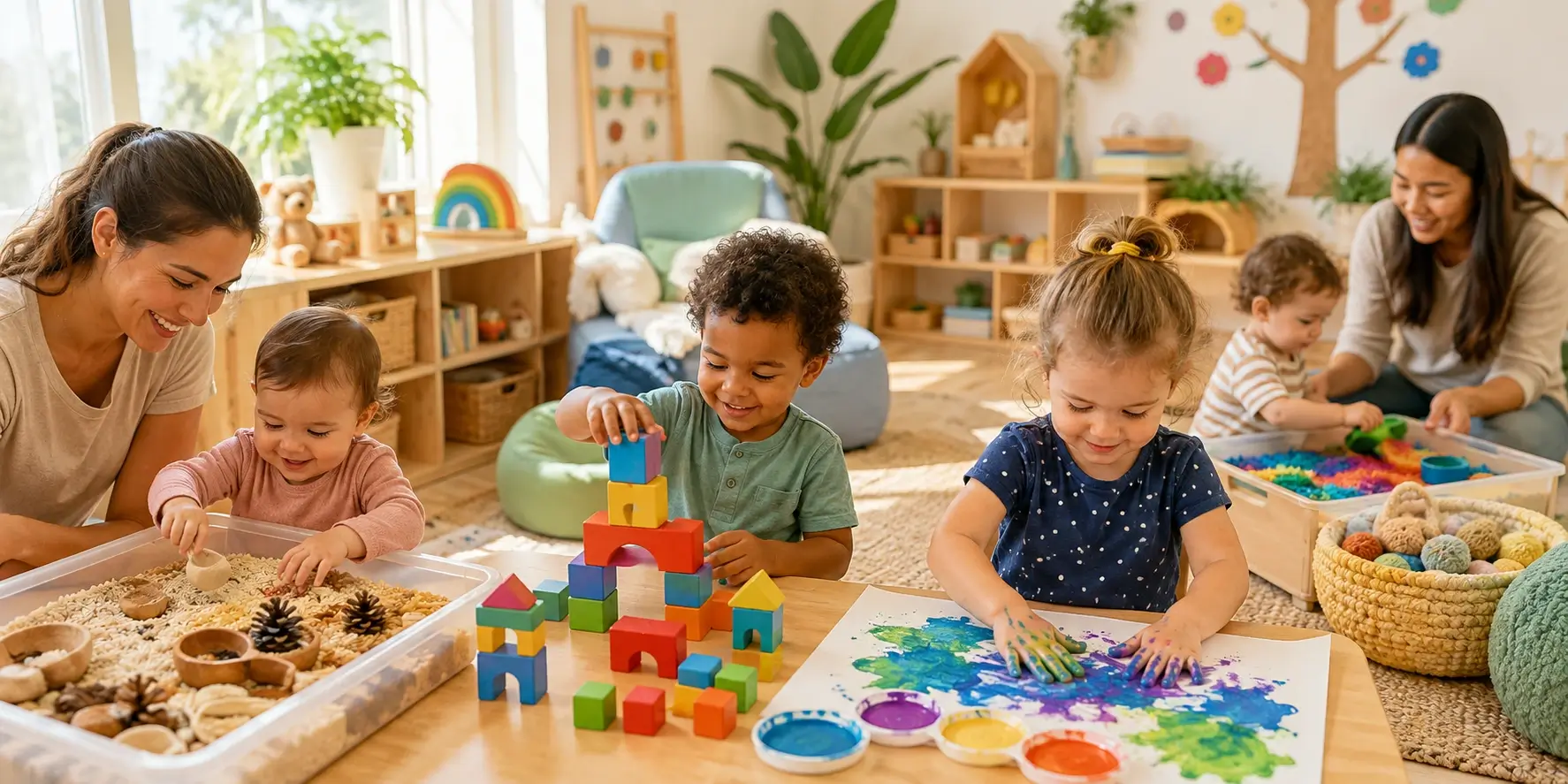
Young children rarely learn through just one sense at a time. When a child splashes water, rolls playdough, listens to music, collects leaves, or builds with blocks, they are seeing, touching, hearing, moving, thinking, and communicating all at once.
These everyday experiences are examples of multi-sensory play. During the early years, this kind of hands-on exploration gives children meaningful ways to understand their surroundings while strengthening skills they will use as they grow. Play may look simple from the outside, but for a developing child, there is often a great deal of learning happening underneath.
What Does Multi-Sensory Play Mean?
Multi-sensory play involves activities that engage more than one sensory system at the same time. Most people think first about sight, sound, touch, smell, and taste, but sensory development also involves movement, balance, and awareness of where the body is in space.
For example, a child playing with playdough may feel its texture, notice its colour, smell it, use hand strength to squeeze it, and listen as an educator introduces words such as soft, flat, round, or sticky. One simple activity can therefore support several areas of development at once.
This is one reason play-based learning is so valuable in early childhood. Young children can explore ideas through experiences that feel natural rather than being expected to learn everything through direct instruction.
Why The Early Years Matter For Sensory Learning
Early childhood is a time of rapid development. Children are learning how their bodies work, how to communicate, how to interact with other people, and how objects in their environment respond to their actions.
Sensory-rich experiences give them opportunities to explore those questions for themselves. Children can touch, compare, move, repeat, and experiment. Over time, these experiences help them make connections between what they do and what happens next.
The goal is not to overwhelm children with constant stimulation. Quality multi-sensory play gives children age-appropriate experiences, enough time to explore them, and supportive adults who notice when to guide and when to let discovery happen naturally.
How Multi-Sensory Play Supports A Learning Brain
Children learn through experience. When several senses are involved, they receive different kinds of information about the same object, action, or idea.
Hands-on exploration gives children opportunities to observe patterns, remember what happened before, test an idea, and change what they are doing when the result is different from what they expected.
Understanding Cause And Effect
Cause and effect appears naturally during sensory play. A child discovers that squeezing dough changes its shape, tipping a cup makes water pour out, and striking a drum creates a sound.
These experiences may seem small, but they introduce an important idea: actions have outcomes. Understanding this relationship supports early reasoning and gives children confidence to keep experimenting.
Learning Through Repetition
Young children often repeat an activity many times. They might fill and empty the same container, build and knock down the same tower, or roll a toy across the same surface repeatedly.
Repetition gives children the chance to check what they have learned. Each attempt can become a small experiment, helping them develop attention, persistence, and a stronger understanding of how things work.
Multi-Sensory Play Encourages Curiosity And Problem-Solving
Open-ended play gives children room to ask questions without needing to say them aloud. Will this block fit? Which container holds more water? What happens if two colours mix? Why does one object sink while another floats?
The child becomes an active participant in learning rather than simply receiving an answer. They can test possibilities, notice differences, make mistakes, and try again.
This is also why hands-on learning in early childhood is so powerful. Everyday materials and experiences can encourage observation, experimentation, creativity, and independent thinking without turning play into a formal lesson.
Touch And Movement Help Build Motor Skills
Sensory learning does not happen only in the mind. Children are constantly developing control over their hands, fingers, arms, legs, balance, and overall body movement.
Multi-sensory activities give them enjoyable reasons to practice these physical skills again and again.
Fine Motor Development
Scooping, pinching, squeezing, threading, stirring, stacking, tearing paper, manipulating playdough, and picking up small age-appropriate objects all require controlled hand and finger movements.
These abilities support everyday independence. As children grow, stronger fine motor control helps with tasks such as feeding themselves, fastening clothing, drawing, using tools, and eventually writing.
Gross Motor Skills And Body Awareness
Movement is also a sensory experience. Jumping, balancing, dancing, climbing, carrying, pushing, and pulling teach children more about what their bodies can do.
Regular opportunities for active play support coordination, balance, strength, and confidence in movement. A well-rounded early childhood curriculum can support physical development by combining active movement with quieter hands-on experiences throughout the day.
Multi-Sensory Experiences Help Language Grow
It is much easier for a young child to understand words such as rough, smooth, heavy, cold, sticky, splash, full, or empty when they are experiencing those ideas at the same time.
Sensory play gives language a real-world meaning. Children are not simply hearing new vocabulary. They are connecting words with what they can see, feel, hear, and do.
Educators can build on these moments by describing what is happening, asking simple questions, introducing comparison words, and giving children time to respond. Conversations during play can feel informal, yet they provide valuable opportunities for listening and communication.
Sensory Play Can Support Emotional Regulation
Young children are still learning how to understand and manage strong feelings. Some sensory experiences can provide a steady, focused activity that helps children become more settled and engaged.
Pouring water slowly, squeezing soft materials, scooping sand, painting, listening to gentle rhythms, or repeating a familiar movement can create calm, predictable experiences. Other children may benefit more from active movement before they are ready for quieter play.
Every child responds differently. One child may immediately explore a new texture, while another watches carefully before joining. A supportive early learning environment respects those differences instead of forcing every child to participate in exactly the same way.
Multi-Sensory Play Is Also Social Play
Many sensory activities happen alongside other children, making them valuable opportunities for early social learning. Sharing a water table, building something together, painting on a large surface, or exploring outdoor materials requires children to become aware of the people around them.
They begin practicing skills such as taking turns, sharing materials, watching what others are doing, communicating ideas, and solving small disagreements.
These everyday interactions contribute to strong social skills in young children. Children learn cooperation gradually through repeated experiences with caring adults and peers, not from a single lesson about sharing.
What Multi-Sensory Learning Looks Like In The Early Years
Multi-sensory play does not require complicated equipment. Some of the richest learning experiences come from ordinary materials and everyday environments.
Children might explore:
- Water, sand, playdough, paint, foam, and textured materials
- Music, clapping, dancing, rhythm, and movement games
- Leaves, stones, soil, snow, grass, and other natural materials
- Blocks, loose parts, puzzles, and imaginative play materials
- Scooping, pouring, sorting, mixing, building, and creating
Outdoor environments are especially rich in sensory experiences. Children can feel different surfaces, hear birds and wind, notice colours, carry natural objects, and move their bodies through changing spaces. These outdoor activities for preschoolers show how nature, physical movement, observation, creativity, and learning can happen together.
Why Multi-Sensory Play Is More Than Making A Mess
Sensory play can sometimes be messy, but mess is not the purpose. A meaningful sensory experience is thoughtfully planned around children’s age, safety, interests, and developmental needs.
Educators choose suitable materials, supervise closely, model safe ways to explore, introduce useful language, and observe how children respond. At the same time, children need enough freedom to make choices, experiment, and discover things themselves.
This balance between thoughtful guidance and independent exploration is important. When adults control every step, children lose some of the problem-solving opportunities that make sensory play valuable.
How Multi-Sensory Play Supports School Readiness
School readiness begins well before children start learning formal reading, writing, or mathematics. Many of the skills children need for kindergarten are built gradually through play and everyday routines.
Multi-sensory experiences can support foundations such as:
- Listening and following simple directions
- Staying engaged with an activity
- Building hand strength and coordination
- Using language to describe ideas
- Solving simple problems
- Participating with other children
- Becoming more independent and confident
These skills complement the broader preschool readiness abilities children build before kindergarten. Play gives children opportunities to practice them in ways that are appropriate for their stage of development.
Multi-Sensory Learning At Chapter1 Daycare
At Chapter1 Daycare, children are encouraged to learn through play, movement, creativity, hands-on activities, outdoor experiences, and positive interaction with educators and peers. Sensory-rich experiences fit naturally into this approach because they allow children to discover ideas in ways that are engaging and meaningful to them. Activities are adapted to children’s developmental stages so infants, toddlers, preschoolers, and children preparing for kindergarten can explore, build confidence, and develop new skills within a warm and supportive environment.
The aim is not to rush children toward academic milestones. It is to give them a strong foundation for learning by supporting curiosity, communication, independence, emotional development, and positive relationships during the years when these abilities are growing rapidly.
Helping Children Explore With Confidence
Children understand the world by interacting with it. They touch, listen, move, watch, compare, experiment, communicate, and repeat experiences until those experiences begin to make sense.
Multi-sensory play brings many of these learning opportunities together. It supports growing minds and bodies while helping children develop curiosity, language, coordination, social confidence, and independence.
When early childhood environments provide safe and thoughtful opportunities to explore, ordinary moments of play can become meaningful steps in development. That is what makes multi-sensory learning such an important part of giving children a creative space to play, learn, and grow.
FAQs
What Is Multi-Sensory Play In Early Childhood?
Multi-sensory play involves activities that engage more than one sensory system at the same time. Children may use sight, sound, touch, smell, movement, balance, or body awareness while exploring an activity.
Why Is Multi-Sensory Play Important In The Early Years?
It gives young children hands-on opportunities to explore how the world works. These experiences can support language, problem-solving, physical coordination, social interaction, curiosity, confidence, and emotional development.
How Does Sensory Play Help Brain Development?
Sensory play lets children connect actions with experiences and outcomes. By observing, repeating, comparing, and experimenting, children build understanding and practice important early thinking skills.
What Are Examples Of Multi-Sensory Play?
Water play, sand, playdough, painting, music and movement, nature exploration, gardening, building activities, sensory bins, and imaginative play can all provide multi-sensory experiences.
What Skills Do Children Develop Through Sensory Play?
Depending on the activity, children can practice fine and gross motor skills, communication, vocabulary, concentration, problem-solving, turn-taking, creativity, independence, and body awareness.
Is Multi-Sensory Play Suitable For Every Child?
Sensory experiences can be adapted to different developmental stages, abilities, interests, and comfort levels. Some children explore new sensory input quickly, while others may prefer to observe first and participate gradually.
How Do Educators Make Sensory Play Meaningful?
Educators choose safe, age-appropriate materials, provide supervision, introduce useful language, ask thoughtful questions, and give children enough independence to explore, experiment, and learn through discovery.