



Choosing a daycare is one of the biggest decisions a parent can make. You are not just looking for a place that watches your child during the day. You are looking for a space where they feel safe, understood, supported, and encouraged to grow.
In a city like Calgary, families have many childcare options to compare. That can feel reassuring, but it can also feel overwhelming. Between location, cost, educator experience, routines, meals, and learning style, it is easy to wonder how you are supposed to know which one is truly right for your child.
Start With Your Family’s Real Needs
Before comparing centres, take a step back and think about your own household. The best daycare is not always the fanciest or the closest. It is the one that fits your child’s personality, your schedule, and your family’s daily rhythm.
Your child’s age and stage
A younger child may need a calmer routine, more one-on-one comfort, and more support with transitions. A preschooler may thrive in a setting that includes early learning, group activities, and more independence throughout the day.
This is why it helps to understand the different types of daycare in Calgary before making a decision. Not every program is built for the same stage of development, and what works beautifully for one child may not feel right for another.
Your schedule and commute
Drop-off and pick-up shape your whole day. A centre that looks great on paper may still create stress if it is far from home, work, or your usual route. For many parents, convenience matters because consistency matters.
A smoother commute can mean calmer mornings, easier evenings, and more energy for your child. That practical side of the decision should never be dismissed. A good fit supports the whole family, not just the classroom hours.
Your budget and flexibility needs
Cost matters, and so does clarity. Parents should feel comfortable asking what is included, what is optional, and how full-time or part-time care is structured.
Flexibility matters too. Some families need a traditional weekly routine, while others need care that better supports changing shifts, longer workdays, or part-time attendance. It is easier to choose with confidence when pricing and scheduling are clearly explained from the beginning.
Understand What Quality Daycare Really Looks Like

Once your non-negotiables are clear, it becomes easier to focus on quality. A strong daycare is not defined by one feature alone. It is the overall experience children and parents have every day.
Licensing and educator qualifications
Many Calgary parents start by checking whether a program is licensed and whether the educators have recognized early learning training. That matters because strong early childhood care depends on more than supervision. It depends on people who understand child development, communication, routine, and age-appropriate learning.
You do not need a centre to sound overly academic to know it takes learning seriously. What you want is a team that can explain how they guide children through play, support social growth, and build trust with families.
Play-based learning with real structure
Many parents are drawn to play-based programs, and for good reason. Healthy play is how young children explore language, relationships, movement, confidence, and problem-solving. But quality play-based learning is not random or chaotic.
If you are comparing programs, look closely at how they talk about their routine and classroom experience. A strong approach to play-based learning includes intentional activities, educator involvement, predictable transitions, and space for children to explore without feeling pressured.
Safety, cleanliness, and communication
Parents should feel that health and safety are handled seriously, not casually. Secure entry, clean classrooms, clear illness policies, organized storage, and attentive supervision all help create peace of mind.
Communication is part of that quality too. You want to know how the centre shares updates, handles concerns, and talks with families about progress, routines, and behavior. Good communication builds trust long before any problem comes up.
Match the Daycare to Your Child, Not Just the Location
A centre may be licensed, clean, and convenient, but it still needs to feel right for your child. That emotional fit is one of the most important parts of the decision.
Infant and toddler needs
Infants and toddlers need nurturing care, gentle routines, and warm educators who respond with patience and consistency. At these ages, children are building trust, attachment, and early communication every single day.
Parents of younger children often want to see how meals, naps, diapering, sensory play, and comfort are handled. If you are exploring early care options, looking at a program like infant day care in Royal Oak can help you picture what age-appropriate care should look like in practice.
Preschool and pre-K readiness
As children grow, parents often start thinking more about confidence, language, friendships, early routines, and school readiness. That does not mean childhood should feel overly academic. It means children benefit from an environment where learning is active, playful, and thoughtfully guided.
If your child is moving into the next stage, it can help to understand preschool vs. pre-K and to notice the signs your toddler might be ready for preschool. Those questions often matter just as much as location or cost.
Temperament and emotional fit
Some children jump into new routines right away. Others need time, reassurance, and familiar faces before they feel comfortable. Neither response is wrong.
When you visit a daycare, look beyond the room setup. Notice how educators speak to children, how they respond to tears or hesitation, and whether the atmosphere feels calm, respectful, and welcoming. A child does not need to be instantly cheerful on day one, but they should be supported with warmth and patience.
What to Ask on a Daycare Tour
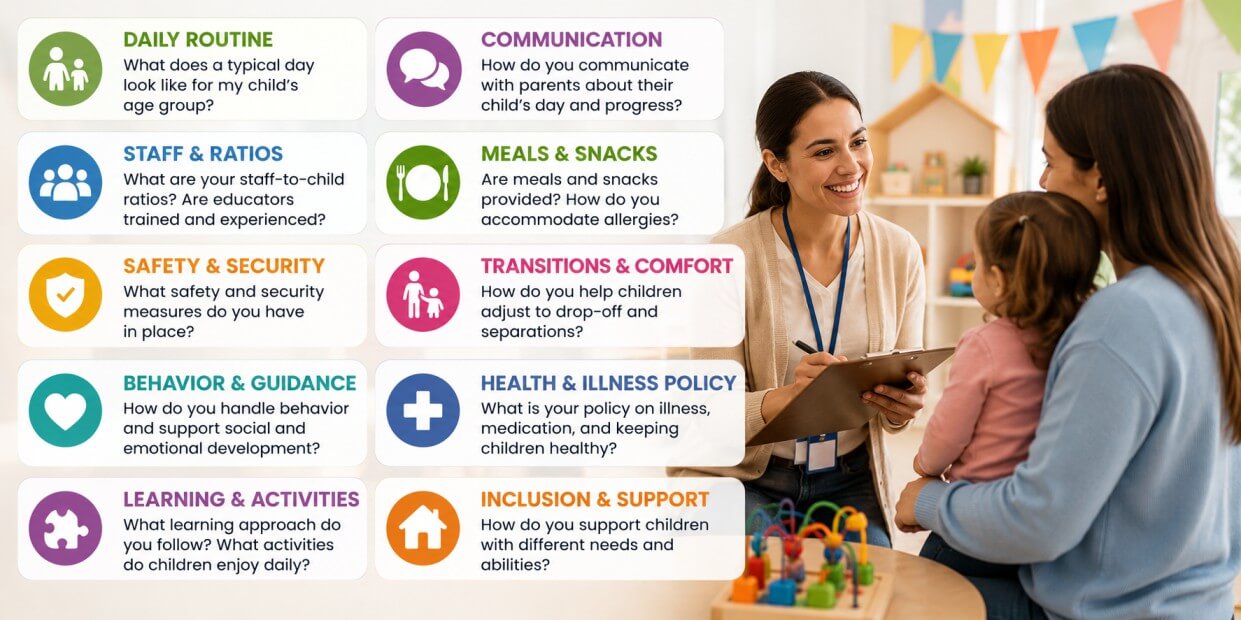
A tour gives you the chance to see beyond the website. It helps you observe the daily environment and hear how the team explains its approach. The right questions can make the visit far more useful.
Here are a few worth asking:
- What does a typical day look like for my child’s age group?
- How do you support children during drop-off and transitions?
- How do educators communicate with families?
- What is included in the monthly fee?
- How do you handle naps, meals, allergies, and illness?
- How do you guide behavior and support social development?
You can also ask how children spend their time during the day. In strong programs, you will usually hear about routines that balance movement, play, meals, quiet time, creativity, and relationship-building. That is often where real quality becomes visible.
Watch for Red Flags You Should Not Ignore
Sometimes parents sense that something feels off even when they cannot explain it right away. That instinct matters. A daycare should not leave you feeling confused, rushed, or uneasy.
Pay close attention if staff seem disconnected, classrooms feel chaotic, answers are vague, or the environment appears poorly maintained. High turnover, inconsistent communication, or pressure to register before you feel ready can also be warning signs.
A strong centre should be able to explain its routine clearly, answer questions comfortably, and make families feel respected from the first conversation.
Compare Cost Without Losing Sight of Value
It is natural to compare fees, especially when childcare is a major household expense. But cost only tells part of the story. Parents should also look at what the fee includes, how transparent the provider is, and whether the experience truly supports their child’s growth and their family’s schedule.
In Calgary, many families weigh affordability alongside quality, flexibility, and location. A program that feels slightly more expensive may still offer better long-term value if communication is stronger, routines are more thoughtful, and the daily experience is more supportive.
For parents who want to see how this balance can look locally, Chapter1 Daycare offers childcare in Calgary with a focus on nurturing care, early learning, and family-friendly routines. Families comparing options can also explore how a play-based daycare in Calgary is structured, what preschool in Cedarbrae looks like, how preschool in NW Calgary supports growing children, or how pre-kindergarten in Cedarbrae helps build confidence before kindergarten.
Start Early and Trust What You See
The best daycare searches usually begin earlier than parents expect. Spaces can fill quickly, especially when families are looking for specific neighborhoods, age groups, or flexible schedules.
Tour more than one option if you can. Compare how each place feels, how clearly the staff communicate, and whether you can picture your child there. Do not ignore the practical details, but do not ignore your gut either.
The Best Daycare Is the One That Fits Your Child
There is no single perfect daycare for every family in Calgary. The right choice depends on your child’s temperament, your family’s routine, and the kind of environment that helps everyone feel secure.
When you focus on safety, educator quality, communication, emotional fit, and everyday routine, the decision becomes clearer. The goal is not just to find childcare. It is to find a place where your child can feel safe, cared for, curious, and confident as they grow.
FAQs
How do I choose the best daycare in Calgary?
Start with your family’s non-negotiables, including your child’s age, your schedule, your commute, and your budget. Then compare providers based on safety, educator quality, daily routine, communication, and overall fit.
What should I look for when touring a daycare?
Look for a clean, organized, welcoming environment with calm classrooms and engaged educators. Ask about daily routines, communication, learning approach, meals, safety practices, and how the team supports transitions.
Is play-based learning a good choice for young children?
Yes, play-based learning can be a strong choice because it supports social, emotional, language, and cognitive development in a natural way. The key is choosing a program where play is guided with purpose and structure.
What questions should I ask before enrolling?
Ask what is included in the fee, what a typical day looks like, how educators communicate with parents, how they support behavior and transitions, and how they handle naps, meals, illness, and safety.
How do I know if a daycare is the right fit for my child?
Watch how your child responds to the environment and how educators interact with children. A good fit usually feels warm, organized, respectful, and reassuring to both parent and child.
What if my child cries at drop-off?
That can be a normal part of adjustment, especially in the beginning. What matters is whether educators respond calmly, consistently, and compassionately while helping your child build trust over time.
When should I start looking for daycare in Calgary?
It is wise to begin earlier than you think you need to. Starting early gives you more time to compare providers, book tours, ask questions, and secure a space that fits your family’s needs.
Does the closest daycare always make the most sense?
Not always, but convenience does matter. A nearby daycare can make routines easier, yet the best choice is usually the one that balances location with quality care, communication, and the right environment for your child.